
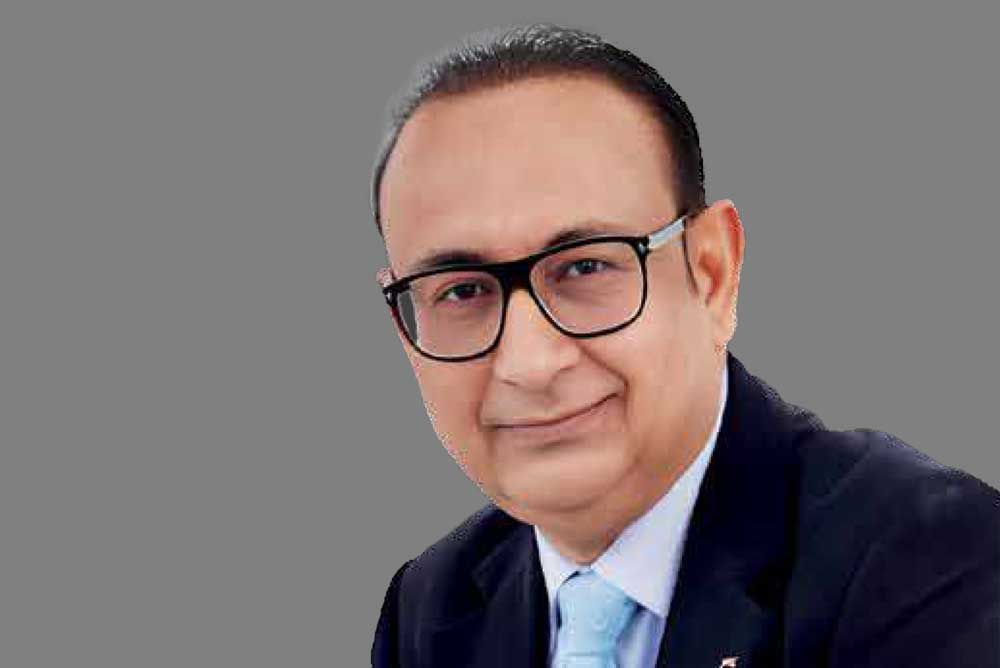
Read Full Magazine Here. Dr. AFTAB Hasan is a Forbes Recognized Professional Entrepreneur, InsureTech Visionary Leader, Author & first-generation entrepreneur who stands as one of the most distinguished figures in the global insurance and reinsurance industry, with over 35 years of pioneering leadership.
His career is decorated with prestigious honors including Insurance Personality of the Year (UIEF), Outstanding CEO of the Year (Global Economic Summit), Business Innovation Award (Informa PLC UK), Burj CEO of the Year (CEO Clubs Networks), and the Lifetime Achievement Award (CEO Clubs Networks), among many others. These accolades reflect his relentless pursuit of excellence, innovation, and governance in the financial services sector.
As Chairman & Board of Trustee of the Global Association of InsurTech Professionals (GAIP) under the auspices of DIFC, Dr. Hasan is spearheading a nonprofit international platform dedicated to advancing InsurTech worldwide. Supported by the United Nations Office for Disaster Risk Reduction (UNDRR), GAIP continues to expand with chapters across continents, serving as a unique hub for collaboration, innovation, and resilience in the insurance ecosystem. His leadership extends further as Secretary-General of the Insurance Business Group (IBG) under Dubai Chambers, Co-Convenor of the Indian Business & Professional Council (BFSI Focus Group), and Advisory Board Director across multiple global trade and industry organizations.
The ongoing geopolitical developments in the Middle East—marked by wars, disputes, and economic volatility—have profound implications for the insurance and reinsurance sector. These challenges underscore the urgent need for structured corporate governance, democratic principles in business leadership, and innovative InsurTech solutions to safeguard industries and societies alike. Dr. Hasan’s vision aligns with these imperatives, positioning GAIP as a beacon of resilience and foresight in uncertain times.
Major Honors & Awards
* ‘Insurance Personality of the Year’ – UAE-India Economic Forum (UIEF)
* ‘Outstanding CEO of the Year’ – Global Economic Summit
*‘Business Innovation Award’ – Informa PLC UK
*‘Burj CEO of the Year’ – The CEO Clubs Networks
* ‘Qadat Al Tagheer Award’ – Bloomberg Middle East & Economic Times.
* ‘Reinsurance Personality of the Year’ – India UAE Strategic Enclave
* ‘India-GCC Awards of Excellence’ – India Economic Trade Organization (IETO)
* ‘Champions of Change’ – Interactive Forum on Indian Economy (IFIE)
* ‘Lifetime Achievement Award’ – The CEO Clubs Networks
BUSINESS LIFE reporter sat down with the brilliant business tycoon Dr. AFTAB Hasan for a unique and echoing cover interview. In this conversation, he detailed his views on the current insurance and reinsurance potentials during the ongoing wars and disputes regionally and globally, and how these dynamics are reshaping economies, social structures, and industries—including the insurance and reinsurance sector. This unique cover interview captures the gravitas of Dr. AFTAB Hasan’s career, his accolades, and the current global context, followed by striking and impactful 19 interview questions:
Governance & Corporate Principles
BL: How do you define strong corporate governance in today’s insurance and reinsurance industry?
Dr. AFTAB Hasan: Strong corporate governance in today’s insurance and reinsurance industry extends far beyond regulatory compliance; it is fundamentally about institutional integrity under conditions of systemic uncertainty. In an era where risks are no longer isolated but deeply interconnected across geopolitical tensions, financial volatility, climate events, and technological disruption, governance must ensure clarity of accountability, transparency in decision-making, and discipline in capital allocation. Insurance is a business built on trust. Governance therefore becomes the invisible architecture that sustains that trust, especially during times when markets are under stress.
As Warren Buffett famously said: “It takes 20 years to build a reputation and five minutes to ruin it.”
In insurance, governance is precisely what protects that reputation.
BL: What role do democratic and structured corporate principles play in building resilient insurance organizations?
Dr. AFTAB Hasan: Resilience in insurance organizations is not a function of individual brilliance; it is a function of institutional continuity and structured decision-making. Democratic and well-defined governance frameworks reduce concentration risk, ensuring that critical decisions are not dependent on a single authority but are instead guided by collective oversight, layered approvals, and disciplined processes.
Such frameworks create organizations where systems prevail over personalities, enabling continuity even during leadership transitions, market shocks, or geopolitical disruptions. In volatile environments, resilience is ultimately the outcome of predictable processes operating within unpredictable conditions.
BL: How can insurers balance profitability with ethical governance in volatile markets?
Dr. AFTAB Hasan: In volatile markets, profitability is best preserved not through opportunism, but through underwriting discipline and ethical restraint. History has repeatedly shown that short-term premium growth; driven by aggressive pricing or relaxed underwriting standards, often results in long-tail liabilities that erode capital over time. Ethical governance ensures that underwriting decisions remain aligned with risk fundamentals rather than market pressure, thereby protecting both balance sheets and reputational capital. Sustainable profitability, particularly in insurance, is not achieved by maximizing risk exposure, it is achieved by selecting risk intelligently and pricing it responsibly.
BL: What lessons from your 35-year career highlight the importance of governance in crisis management?
Dr. AFTAB Hasan: Over three decades of witnessing wars, financial crises, and global disruptions, one lesson stands out with absolute clarity: Crises do not create vulnerabilities, they reveal them.
Organizations with strong governance frameworks respond with coherence, agility, and strategic clarity, while those lacking structure tend to react impulsively. During crises, governance ensures decisions are guided by discipline rather than fear.
As Winston Churchill once observed: “Never let a good crisis go to waste.”
For well-governed institutions, crises become opportunities to demonstrate strength rather than moments of collapse.
BL: How do you see regulatory frameworks evolving in the Middle East to strengthen governance in insurance?
Dr. AFTAB Hasan: The Middle East is undergoing a significant transformation in its regulatory landscape, particularly in leading jurisdictions such as DIFC and ADGM.
Regulatory frameworks are increasingly aligned with global best practices, with a strong emphasis on:
Risk-based supervision
Capital adequacy and solvency frameworks
Enterprise risk management (ERM)
ESG integration and sustainability reporting
Enhanced compliance and transparency standards
The shift is clear; from rule-based regulation to principle-based and risk-sensitive supervision.
This evolution is not only strengthening governance but also positioning the region as a credible and competitive insurance hub within the global ecosystem.
InsurTech & Innovation
BL: What is InsurTech, and why is it becoming a cornerstone of the insurance industry?
Dr. AFTAB Hasan: InsurTech represents the convergence of technology and insurance, fundamentally transforming how risk is assessed, priced, distributed, and serviced. It is no longer a competitive advantage; it is a structural necessity.
In today’s environment, insurers must operate with speed, precision, and scalability, which can only be achieved through the integration of technologies such as artificial intelligence, data analytics, and automation.
InsurTech is not merely about digitization, it is about redefining the insurance value chain to be more predictive, responsive, and customer centric.
BL: How is GAIP uniquely positioned to drive global innovation in InsurTech?
Dr. AFTAB Hasan: GAIP is uniquely positioned because it operates as a neutral, non-commercial global platform, bringing together insurers, reinsurers, regulators, technologists, and policymakers under one ecosystem.
Supported by DIFC and aligned with global frameworks such as UNDRR, GAIP’s strength lies in its ability to bridge silos and foster cross-border collaboration.
In an industry that has traditionally operated in fragmented structures, GAIP creates a unified platform for dialogue, innovation, and collective problem-solving.
BL: What strategies are GAIP implementing to expand chapters worldwide and foster collaboration?
Dr. AFTAB Hasan: GAIP’s expansion strategy is built on a “global vision with local execution” approach.
By establishing chapters across key markets, we are creating an interconnected ecosystem that promotes:
knowledge exchange
regulatory dialogue
innovation partnerships
capacity building
The objective is not merely expansion, but integration, connecting global expertise with regional insights.
BL: How do you see artificial intelligence and blockchain reshaping insurance operations?
Dr. AFTAB Hasan: Artificial Intelligence is revolutionizing insurance by enabling predictive underwriting, real-time risk assessment, automated claims processing, and fraud detection.
Blockchain, on the other hand, is introducing transparency, immutability, and contract certainty, particularly in areas such as reinsurance and parametric solutions.
Together, these technologies are redefining insurance from a reactive indemnity model to a proactive risk management framework. They are not replacing trust, they are enhancing and digitizing it.
BL: What role does InsurTech play in disaster risk reduction and resilience building?
Dr. AFTAB Hasan: InsurTech is enabling a fundamental shift from risk transfer to risk prevention.
Through real-time data analytics, satellite monitoring, IoT integration, and parametric insurance solutions, insurers can now respond to events faster, more accurately, and more efficiently. This significantly reduces recovery timelines and enhances resilience at both micro and macro levels.
In the context of increasing global catastrophes and geopolitical risks, InsurTech is becoming a critical tool for building resilient economies.
Middle East & Global Context
BL: How are ongoing conflicts in the Middle East impacting the insurance and reinsurance sector?
Dr. AFTAB Hasan: The ongoing conflicts in the Middle East are fundamentally reshaping how risk is perceived, priced, and managed across the global insurance and reinsurance ecosystem. What we are witnessing is not merely a temporary market reaction, but a structural recalibration of risk frameworks under geopolitical stress.
At the most immediate level, there has been a sharp increase in war-risk premiums, particularly across marine hull and cargo, aviation war covers, and energy infrastructure insurance. Critical transit routes such as the Strait of Hormuz and adjacent shipping corridors are now being assessed under heightened threat scenarios, leading to revised risk ratings, additional premiums (APs), and more restrictive policy terms, including shorter notice periods for cancellation of war cover.
From an underwriting perspective, there is a noticeable contraction in risk appetite, especially for exposures linked to high-risk zones. Insurers are reassessing accumulations across portfolios, with a stronger focus on aggregation risk; where a single geopolitical event could trigger losses across multiple lines of business simultaneously, including property, marine, aviation, and political risk.
For reinsurers, the implications are even more pronounced. Global reinsurance markets, particularly in London, Bermuda, Zurich, and Singapore are actively recalibrating their capacity deployment strategies. This includes tightening treaty terms, increasing attachment points, and repricing catastrophes and specialty lines to reflect elevated uncertainty. There is also a growing emphasis on shorter duration covers and flexible structures, allowing reinsurers to respond dynamically to rapidly evolving geopolitical developments.
Another critical dimension is the increasing overlap between traditional war risk, terrorism risk, and cyber risk. Modern conflicts are no longer confined to physical damage alone; they involve cyber disruptions, infrastructure targeting, and supply chain interference. This convergence creates complex coverage challenges, particularly around policy triggers, exclusions, and claims interpretation.
Risk, therefore, is no longer being assessed purely through actuarial models based on historical data. It is increasingly being evaluated through a forward-looking geopolitical and macroeconomic lens, incorporating scenario analysis, intelligence inputs, and real-time monitoring.
As John F. Kennedy once warned: “Mankind must put an end to war before war puts an end to mankind.”
From an insurance perspective, this is not merely a philosophical observation; it reflects the systemic escalation of risk that conflicts introduce into global markets, where the financial consequences extend far beyond the battlefield, impacting capital flows, trade stability, and the very foundations of insurability itself.
BL: What opportunities do you see despite these geopolitical challenges?
Dr. AFTAB Hasan: While geopolitical instability introduces significant uncertainty, it simultaneously creates structural opportunities for innovation and market evolution within the insurance and reinsurance sector. Historically, periods of disruption have often acted as catalysts for the development of new products, risk frameworks, and capital deployment strategies and the current environment is no exception.
One of the most immediate areas of opportunity lies in the growing demand for political violence risk insurance, particularly from multinational corporations, infrastructure investors, and lenders operating in or exposed to volatile regions. As sovereign risk and contract enforceability come under pressure, insurers have an opportunity to provide structured solutions that protect investments against expropriation, currency inconvertibility, and political violence.
At the same time, we are witnessing a notable shift toward parametric insurance solutions, especially for risks that are difficult to model or settle through traditional indemnity-based frameworks. In a conflict-driven environment where speed of response is critical, parametric covers, triggered by predefined events such as port closures, airspace disruptions, or energy supply interruptions, offer rapid liquidity and greater certainty of claims settlement, making them increasingly attractive to both corporates and governments.
Another significant opportunity is emerging in trade credit and supply chain protection. With global trade routes facing disruptions and counterparty risks increasing, businesses are seeking insurance solutions that can safeguard receivables, mitigate payment defaults, and ensure continuity of operations. This is particularly relevant for sectors dependent on cross-border trade, energy flows, and logistics networks.
From a reinsurance perspective, there is growing scope for structured and innovative risk transfer mechanisms, including layered programs, facultative placements for high-risk exposures, and the use of alternative capital through insurance-linked securities and hybrid structures. These approaches enable insurers to optimize capital efficiency while maintaining underwriting discipline in a volatile risk environment.
Importantly, the current geopolitical landscape is also accelerating the adoption of advanced risk modeling and real-time analytics, creating opportunities for insurers who can integrate data, technology, and geopolitical intelligence into their underwriting processes. This evolution is not only enhancing risk selection but also enabling the development of more tailored and responsive insurance products.
In essence, while volatility may constrain traditional underwriting appetite, it simultaneously expands the frontier for specialty lines, innovation-driven solutions, and strategic partnerships. Insurers and reinsurers who can adapt quickly, embrace new risk paradigms, and align their offerings with emerging global needs will not only navigate the current environment successfully but also position themselves for sustainable long-term growth.
BL: How do you foresee reinsurance adapting to heightened global risks?
Dr. AFTAB Hasan: Reinsurance is evolving toward greater flexibility and responsiveness. This includes:
shorter-duration contracts
dynamic pricing mechanisms
diversified capital sources
increased use of alternative risk transfer instruments
There is also a growing reliance on advanced analytics and scenario modeling to manage accumulation risk across geographies.
Reinsurance is no longer just about capacity; it is about intelligent capital deployment.
BL: What parallels can be drawn between Middle Eastern markets and global trends?
Dr. AFTAB Hasan: The Middle East insurance and reinsurance markets increasingly mirror global industry trends, particularly in areas such as climate risk exposure, digital transformation, capital pressures, and risk accumulation across interconnected portfolios. However, what distinguishes the region is the additional layer of geopolitical complexity, which amplifies both risk and opportunity in equal measure.
From a risk perspective, the region is experiencing similar challenges seen globally rising frequency and severity of climate-related events, increasing urban concentration leading to higher insured values, and growing interdependencies across supply chains and infrastructure. These factors contribute to accumulation risk, where a single event can trigger multi-line losses across property, energy, marine, and business interruption portfolios.
At the same time, the Middle East is rapidly advancing in digital adoption and InsurTech integration, often at a pace comparable to, or even exceeding, some developed markets. Governments and regulators in key jurisdictions such as the UAE and Saudi Arabia are actively encouraging innovation through regulatory sandboxes, digital frameworks, and forward-looking policies. This aligns closely with global trends where insurers are leveraging data analytics, artificial intelligence, and automation to enhance underwriting precision and operational efficiency.
From a capital and reinsurance standpoint, the region is also influenced by global market cycles, including hardening reinsurance conditions, capacity constraints, and increasing cost of capital. Insurers in the Middle East, much like their global counterparts, are required to adopt more disciplined underwriting practices, optimize capital deployment, and strengthen enterprise risk management frameworks.
What makes the Middle East particularly unique, however, is the overlay of geopolitical risk, which introduces an additional dimension to underwriting and capital allocation decisions. Unlike many global markets where risks are predominantly economic or environmental, insurers in this region must continuously factor in political stability, regional tensions, and potential conflict scenarios, all of which can have immediate and wide-ranging financial implications.
This dual dynamic, where global trends intersect with regional complexities, positions the Middle East as both a testing ground and an opportunity hub for the insurance industry. It is a market where innovation is not driven by convenience but by necessity, and where resilience is not theoretical but operational.
In this context, success requires more than technical capability. It demands strategic foresight, adaptability, and the ability to navigate uncertainty with precision. For insurers and reinsurers willing to engage with this complexity, the region offers not only challenges but also the potential for meaningful growth and long-term value creation.
BL: How can insurers contribute to stabilizing economies during wars and disputes?
Dr. AFTAB Hasan: Insurance plays a critical role as a financial stabilizer during crises. By enabling risk transfer, facilitating liquidity through claims settlements, and supporting business continuity, insurers help sustain economic activity even under stress. More importantly, insurance restores investor confidence, which is essential for recovery. In many ways, insurance acts as the shock absorber of the global economy.
This aligns with the broader philosophy of resilience captured by Nelson Mandela:
“The greatest glory in living lies not in never falling, but in rising every time we fall.”
Insurance enables that rise.
Personal Vision & Leadership
BL: What has been your most defining leadership moment?
Dr. AFTAB Hasan: The establishment of GAIP stands as my most defining leadership moment; not merely as an institutional milestone, but as the realization of a long-held vision that evolved through years of industry experience, reflection, and conviction.
The idea of GAIP did not emerge overnight. It was shaped over decades of working within the insurance and reinsurance ecosystem, where I observed a persistent structural gap, an industry rich in expertise, yet fragmented in collaboration; advanced in underwriting, yet slow in embracing technological transformation in a unified manner.
The turning point came during the COVID-19 pandemic, which exposed the limitations of traditional insurance models and accelerated the need for digital adoption. It became evident that the future of insurance could not be built in silos. It required a platform that could bring together insurers, reinsurers, technologists, regulators, and policymakers under a shared vision of progress.
That was the moment of conceptual clarity.
From conception, the journey moved into visualization, defining what GAIP should represent. It was never intended to be just another industry body. It was envisioned as a neutral, non-commercial, globally inclusive platform, rooted in collaboration rather than competition, and aligned with broader global resilience agendas.
The execution phase required translating vision into structure, establishing GAIP within the DIFC framework, building governance, engaging global stakeholders, and creating an ecosystem that could scale across geographies. This phase demanded not only strategic planning but also persistence, credibility, and the ability to align diverse interests toward a common purpose.
The launch of GAIP was not the end of that journey, it was the beginning of a larger movement. Today, with expanding global chapters in various demography, strategic partnerships, and initiatives such as GAIP Academy and GAIP TV, the platform continues to evolve into what it was always meant to be:
A bridge between insurance and technology, between local markets and global perspectives, and between present challenges and future solutions.
In many ways, GAIP reflects a fundamental shift in leadership philosophy, from building organizations to building ecosystems, from competing for market share to collaborating for collective progress.
It reflects a shift from competition to collaboration.
BL: What is your vision for GAIP and the industry over the next decade?
Dr. AFTAB Hasan: My vision for GAIP over the next decade is to establish it as the global nucleus of InsurTech collaboration, a platform where innovation, policy dialogue, and capacity building converge to shape the future of the insurance industry.
At its core, GAIP was created with a clear purpose, to bridge the gap between traditional insurance frameworks and emerging technologies, while fostering a culture of collaboration over competition. The industry today stands at a critical inflection point, where the convergence of artificial intelligence, data analytics, climate risk, and geopolitical uncertainty is redefining how risk is understood and managed. In such an environment, isolated excellence is no longer sufficient. The future belongs to ecosystems that can integrate knowledge, share intelligence, and co-create solutions at scale.
Over the next decade, GAIP aims to play a central role in enabling this transformation by building a globally connected platform that brings together insurers, reinsurers, regulators, technologists, academia, and policymakers. Through structured engagement across its international chapters, GAIP will facilitate cross-border knowledge exchange, regulatory dialogue, and innovation partnerships, ensuring that advancements in one part of the world can be adapted and implemented in another.
A key pillar of this vision is education and capacity building through GAIP Academy, which is intended to prepare the next generation of insurance professionals to operate in an increasingly digital and data-driven environment. Equally important is the role of platforms such as GAIP TV and global conferences, which will continue to amplify thought leadership and create meaningful conversations around the evolving risk landscape.
Beyond innovation, GAIP’s long-term vision is closely aligned with the broader objective of building resilience within societies and economies. Insurance must evolve from being a passive risk transfer mechanism to an active contributor in disaster risk reduction, sustainability, and economic stability. GAIP seeks to support this transition by encouraging the development of solutions that are not only technologically advanced but also socially relevant and globally scalable.
In essence, GAIP is not just building an organization, it is nurturing a global movement that redefines how the insurance industry collaborates, innovates, and serves society.
As Mohammed bin Rashid Al Maktoum, Vice President - Prime Minister of UAE and Ruler of Dubai has aptly said: “The future belongs to those who can imagine it, design it and execute it.”
GAIP is built to do exactly that to transform vision into execution, and execution into lasting impact on a global scale.
BL: What are your immediate plans for GAIP?
Dr. AFTAB Hasan: Our immediate focus for GAIP is centered around building a truly interconnected global ecosystem that brings together knowledge, innovation, and collaboration across the insurance and technology landscape.
At the forefront of this effort is the expansion of GAIP’s international footprint through the establishment of global chapters in key strategic markets such as the US, UK, Australia, Japan, China, UAE, Saudi Arabia, Turkey, India, Singapore, Brazil, and other emerging hubs. These chapters are not merely symbolic extensions; they are designed to function as localized centers of engagement, enabling dialogue between regional stakeholders while remaining aligned with a unified global vision.
In parallel, we are progressing with the launch of GAIP Academy, which is a critical pillar in our long-term strategy. The objective is to bridge the growing skills gap within the industry by offering structured education, executive training, and certification programs focused on InsurTech, risk management, and emerging technologies. In a rapidly evolving industry, knowledge is no longer static; it must be continuously developed, and GAIP Academy is intended to institutionalize that learning process and we look forward to emerging as a Deem University soon dedicated to the insurance and insuretech education.
Another key priority is the scaling of GAIP TV, which serves as a digital platform to amplify thought leadership, industry insights, and global conversations. Through curated content, interviews, and expert-led discussions, GAIP TV is designed to democratize access to knowledge and ensure that ideas and innovations are shared across borders in real time.
Additionally, we are actively organizing and expanding our portfolio of international conferences and forums across major markets. These platforms play a vital role in bringing together industry leaders, regulators, innovators, and investors to exchange ideas, explore partnerships, and collectively address the challenges shaping the future of insurance.
Taking together, these initiatives are not standalone projects; they are interconnected components of a larger vision. The aim is to create a dynamic global ecosystem where education, innovation, and collaboration converge, enabling the insurance industry to evolve in a more resilient, inclusive, and future-ready manner.
BL: How will these align with long-term resilience goals?
Dr. AFTAB Hasan: Alignment is achieved through purpose-driven execution. Every initiative is designed to contribute toward a resilient, inclusive, and future-ready insurance ecosystem, capable of responding to both current and emerging risks.
In a world increasingly shaped by uncertainty and geopolitical complexity, the insurance industry must evolve from a risk-bearing entity to a resilience-enabling force.
And as Zayed bin Sultan Al Nahyan, President of UAE so profoundly articulated: “Unity is the foundation for ensuring stability and a better life for our people.”
The future will belong to those who embrace collaboration, uphold governance, and innovate with purpose; because in an interconnected world, resilience is no longer optional; it is the foundation of sustainable progress.
Closing Note
As the insurance and reinsurance industry navigates one of the most turbulent periods in modern history, Dr. AFTAB Hasan emerges as a voice of clarity, resilience, and innovation. His leadership through the Global Association of InsurTech Professionals (GAIP), supported by DIFC and UNDRR, is not only shaping the future of InsurTech but also reinforcing the principles of governance and structured corporate responsibility that the industry desperately needs.
From his decorated career spanning over three decades to his current mission of building a global InsurTech movement, Dr. Hasan’s journey reflects the power of vision, adaptability, and foresight. His strategies for the remainder of this year, coupled with his long-term outlook, demonstrate a commitment to ensuring that insurance remains a stabilizing force in economies and societies worldwide.
With wars, disputes, and economic uncertainties reshaping the global landscape, Dr. Hasan’s insights remind us that insurance is more than a financial instrument—it is a safeguard for humanity’s progress.
BUSINESS LIFE proudly presents this cover interview as a testament to Dr. Hasan’s enduring impact and his unwavering dedication to advancing the insurance and reinsurance sector on a global scale.
Editor’s Preface
At BUSINESS LIFE, we believe that leadership is best measured not only by accolades but by the ability to steer industries through uncertainty. In a year defined by geopolitical turbulence, economic volatility, and rapid technological transformation, few figures embody resilience and foresight as profoundly as Dr. AFTAB Hasan.
His decorated career, spanning more than three decades, has consistently pushed the boundaries of insurance and reinsurance, while his current mission through the Global Association of InsurTech Professionals (GAIP) reflects a bold commitment to innovation, governance, and global collaboration. Supported by DIFC and UNDRR, GAIP is more than an organization—it is a movement shaping the future of InsurTech worldwide.
This cover interview is not just an interview; it is a window into the mind of a visionary who continues to redefine the insurance landscape in times of turmoil. We are proud to feature Dr. Hasan as our cover personality, offering readers an in-depth look at his strategies, his vision, and his unwavering dedication to building resilience in industries and societies across the globe.